

speac_sign_mobile.jpg
SPEAC

Safe non-food consumer Products in the EU and China

Chemistry sets

Chemistry sets

Share this:

Product definition

Chemistry sets are considered to be toys when designed or intended, whether or not exclusively, for use in play by children under 14 years of age. There are two types of chemistry toys included in this document:

1. Experimental sets for chemistry. Examples include crystal growing sets and carbon dioxide generating experiments
2. Chemical toys (sets) other than experimental sets. Examples include moulding sets and oven-hardening modelling clay sets, embedding sets for preserving items and adhesives and paints etc. supplied or recommended for model sets

Common risks of chemistry sets

The most common risks identified in this product sector are set out below.

1. Chemical risks:

  • Dangerous chemicals can cause short- and long- term adverse health effects if they exceed allowed limits.

2. Mechanical/physical risks:

  • Small parts can cause choking in children under the age of 36 months.
  • Sharp edges and points can cause cuts, bruising and other injuries.
  • Rotating parts can cause injuries if they are touched by the consumer while spinning.

3. Thermal risks:

  • Hot surfaces can cause burns.
  • Poorly insulated or fixed wires or substandard components can short circuit and create arcs or overheating, leading to fire.
Further risks if chemistry set contains electrical components:

Electrical risks

  • Live parts can cause electric shock.
  • Non-visible radiation can cause electromagnetic disturbance, such as interference with medical devices.

Optical risks

  • High-intensity light (e.g. lasers, LEDs and blue light) can cause damage to sight.

Risks from batteries

  • Short-circuits in the internal wiring or electronics can cause overheating of batteries or explosion, leading to leakage of dangerous chemicals.
  • Accessible small batteries (AAA or smaller) can be put in the mouth and swallowed, causing choking and damage to the gastrointestinal tract.
Further risks if chemistry set contains electrical components

This is a list of examples of common risks. However, the manufacturer has to carry out an assessment of the toy that covers all relevant risks that may be associated with the product and actions taken to mitigate these risks where possible. A general definition of risk and its relationship to hazards can be found in the factsheet on Risk management

Examples of dangerous products

Specific examples of measures taken against dangerous chemistry sets offered for sale in the European Union are available on the Safety Gate website. Type ‘chemistry sets’ into the free text search box (but without the quotation marks) and select the ‘Toys’ Product Category to view notified examples. A better understanding of mistakes made in the safety assessment of the toy or its manufacture can help avoid their repetition.

Main applicable legislation

These products are governed mainly by the Toy Safety Directive (2009/48/EC) (also available in Chinese). The Directive lays down the safety criteria that all toys must meet before they can be marketed in the EU. Toys must comply with the essential safety requirements set out in this Directive. More specific details can be found here.

NB: For toys, certificates are only recommended, as well as involving a third-party laboratory in the conformity assessment excluding exceptional cases (if the manufacturer doesn’t follow the harmonised standards).

Applicable standards

“Harmonised standards” exist in the EU for toys. A toy complying with these standards is presumed to be in conformity with the essential safety requirements set out in the Toy Safety Directive if the standards are referenced in the Official Journal of the European Union (OJEU). 

Note: The site of CEN (the European standardisation organisation) provides links to the national standardisation bodies’ websites. In addition, the China Standards Information Services Network can be used to access European standards.

The following standard applies to toys:

EN71 Toys

The standard has been published in 14 parts. The most relevant parts for chemistry toys are:

  • EN 71-1: Mechanical and physical properties
  • EN 71-2: Flammability
  • EN 71-3: Specification for migration of certain elements
  • EN 71-4: Experimental sets for chemistry and related activities
  • EN 71-5: Chemical toys (sets) other than experimental sets
  • EN 71-9: Organic chemical compounds – Requirement
  • EN 71-10: Organic chemical compounds – Sample preparation and extraction
  • EN 71-11: Organic chemical compounds – Methods of analysis
  • EN 71-12: N-Nitrosamines and N-Nitrosatable Substances
  • EN 71-13: Olfactory Board Games, Cosmetic kits and Gustative Games

However, the standard series covers other safety issues and manufacturers are strongly advised to consult all parts. It is important to note that the latest edition of the standard referenced in the OJEU (including any amendments) should be applied.

The toy has at least one electrical component and/or function

Standard EN IEC 62115:2020 with the amendment EN IEC 62115:2020/A11:2020 applies to electric toys, i.e. toys having at least one function dependant on electricity. The standard covers the safety of electric toys in relation to their electrical function. It reduces risks when playing with electric toys, especially those risks that are not evident to users. Key parts of the standard are:

  • Small Batteries
  • Battery Compartment Fasteners
  • Requirements for the safety of light emitting toys (especially LEDs)
  • Requirements for the safety of remote-controlled Ride-on-toys.
  • Clearance and creepage distances to address electric shock and fire risks

However, the standard series covers other safety issues and manufacturers are strongly advised to consult all parts. It is important to note that the latest edition of the standard referenced in the OJEU (including any amendments) should be applied.

In addition, if the electrical appliance and equipment is capable to communicate wirelessly, (e.g. incorporates Bluetooth or Wi-Fi used for remote control), it should meet the requirements of the Radio Equipment Directive (2014/53/EU).

See related requirements
The toy is intended for children under 36 months

Small parts in toys

Toys intended for use by children under 36 months as well as their component parts and any of their detachable parts must be of such dimensions as to prevent their being swallowed or inhaled.

If the toy (or separate part) fits completely into the small parts cylinder – defined in standard EN 71-1: Mechanical and physical properties – it will be defined as a small part and will therefore fail to meet this requirement of the Toy Safety Directive.

Specific limits for chemicals

Toys intended for children under 36 months need to respect stricter limit values for certain chemicals, as listed in Appendix C to Annex II to the Toy Safety Directive. In addition, specific migration limits for nitrosamines and nitrosatable substances are set out for these two categories of toys in Annex II Part 3 Point 8 of the Directive.

Hygiene

Toys intended for use by children under 36 months must be designed and manufactured in such a way that they can be cleaned. The toy shall fulfil the safety requirements also after having been cleaned.

See related requirements

Other legislation of relevance:

While manufacturer’s need to familiarise themselves with all the laws which apply to their specific products, the following summarises some further key applicable laws:

  • The REACH regulation restricts chemical substances in goods. REACH stands for “Registration, Evaluation, Authorisation and Restriction of Chemicals”, and it places responsibility on the industry to manage the risks from chemicals and to provide safety information on the substances. The European Chemicals Agency (ECHA) maintains a list of substances of very high concern (the “SVHC list”). According to article 56(1) of the Regulation, manufacturers shall not place products containing any of the substances on this list on the market. The updated list of substances of very high concern can be found on ECHA’s website.
  • CLP Regulation (Classification, labelling and packaging of substances and mixtures) – This Regulation requires manufacturers to classify, label and package their hazardous chemicals appropriately before placing them on the market. These provisions also apply to toys that are or contain chemical products, like for example chemical sets, finger paint, and slime toys.
  • Please note that every product must be safe for the consumers, whether it is a toy or not, according to the General Product Safety Regulation (GPSR) of the EU.

Mandatory labelling & warnings

The following are obligatory:

  • CE Marking is obligatory for all toys. Before marking the toy with the CE mark, the manufacturer needs to carry out a safety assessment on the toy and identify all the applicable essential safety requirements, verify the conformity of the toy with these requirements, compile a technical documentation that evidences this and create a written declaration of conformity. When this has been done, he should affix the CE mark on the product. Refer to the factsheet on CE marking.
  • Information on the manufacturer and the importer in the EU is obligatory.
  • Marking required by the CLP Regulation.

Warnings and instructions for use need to draw attention of users and supervisors to the inherent hazards and associated risks and how to avoid injury.

Safety warnings are obligatory for many types of toys including chemistry sets. For example, toys not suitable for children under 3 years old must include a warning stating “Not suitable for children under 36 months” or “Not suitable for children under three years” or a warning in the form of the graphic below. The warning shall be accompanied by a brief indication, which may appear in the instructions for use, of the specific hazard calling for this precaution.
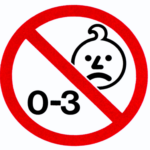
Attention! This warning should be used only in circumstances where the toy is genuinely NOT intended for children under 3 years old and does not exempt manufacturers from complying with specific additional requirements imposed on these types of toys.

General safety requirements

To ensure safety of chemistry sets there is also a range of general requirements to be fulfilled. These are explained in the following factsheets and need to be read in conjunction with this factsheet:

You may also visit the SPEAC ACADEMY to learn more about the EU Safety requirements.

Disclaimer

The provided information was updated in 2025. Please note that some of the provided information could change during possible subsequent revisions of legislation, standards, and guidance documents. 

This document was produced with the financial support of the European Union. Its contents are the sole responsibility of SPEAC project and do not necessarily reflect the views of the European Union.